
Can a small model work out a rule it has never seen, just from examples?
Each Teenie episode is 999 examples (a, b, c) of a hidden relation
on 16- or 32-bit integers (a random expression, a conditional, a loop)
plus one new (a, b). The model is never told the relation, and its
weights never change while it answers. In a single forward pass it has
to infer the rule and produce every bit of c.
At 32 bits a lucky guess is one in four billion, and the 999 examples cover a vanishing fraction of all inputs, so every right answer has to come from reasoning over the examples rather than looking one up.
  examples (999, rule hidden)          question
  a 10001111  b 00011110  c 11000010
  a 11110001  b 00100001  c 00010001     a 10100101
  a 11110011  b 11111110  c 00011010     b 00100010
  ⋮                                      c ????????  → refine 8 rounds
Figure 1: An 8-bit episode, shortened. The model sees examples and a question, never the rule
How it answers
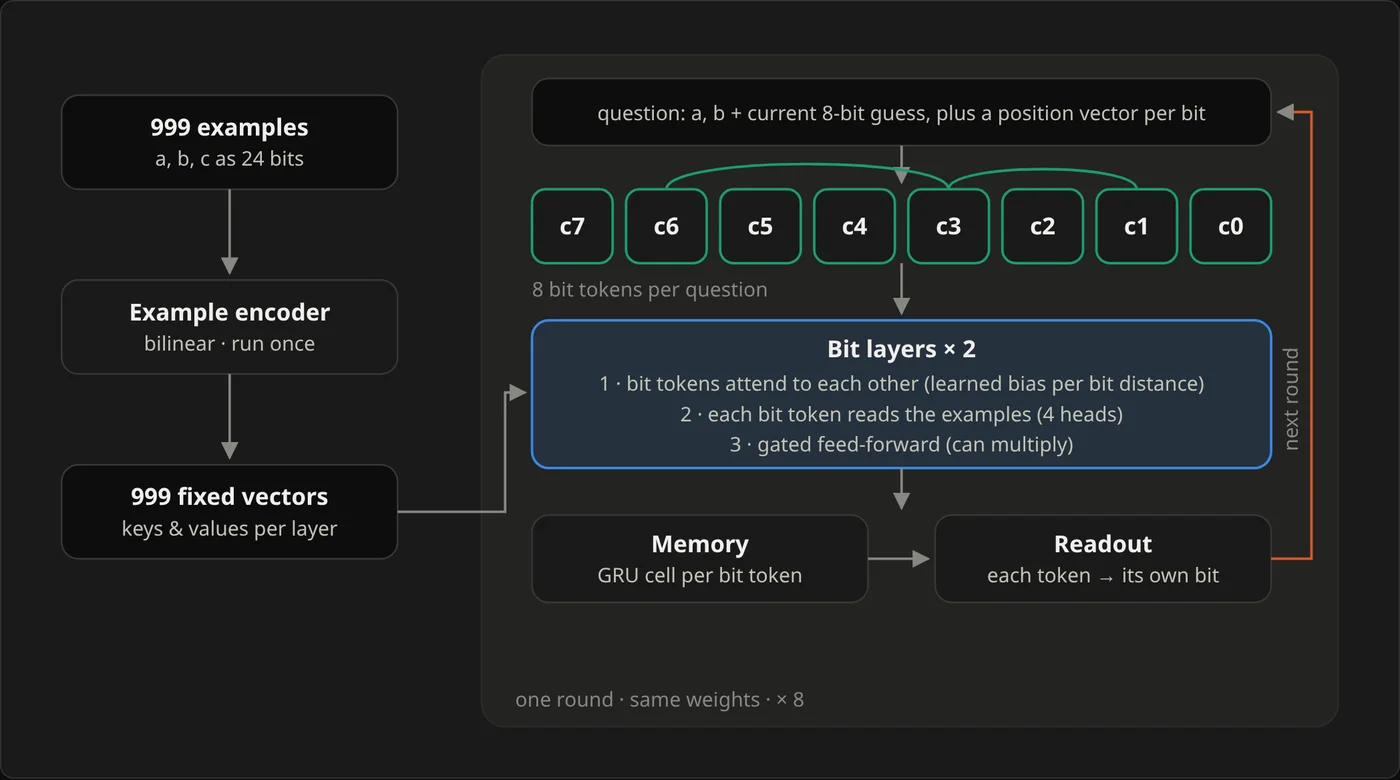
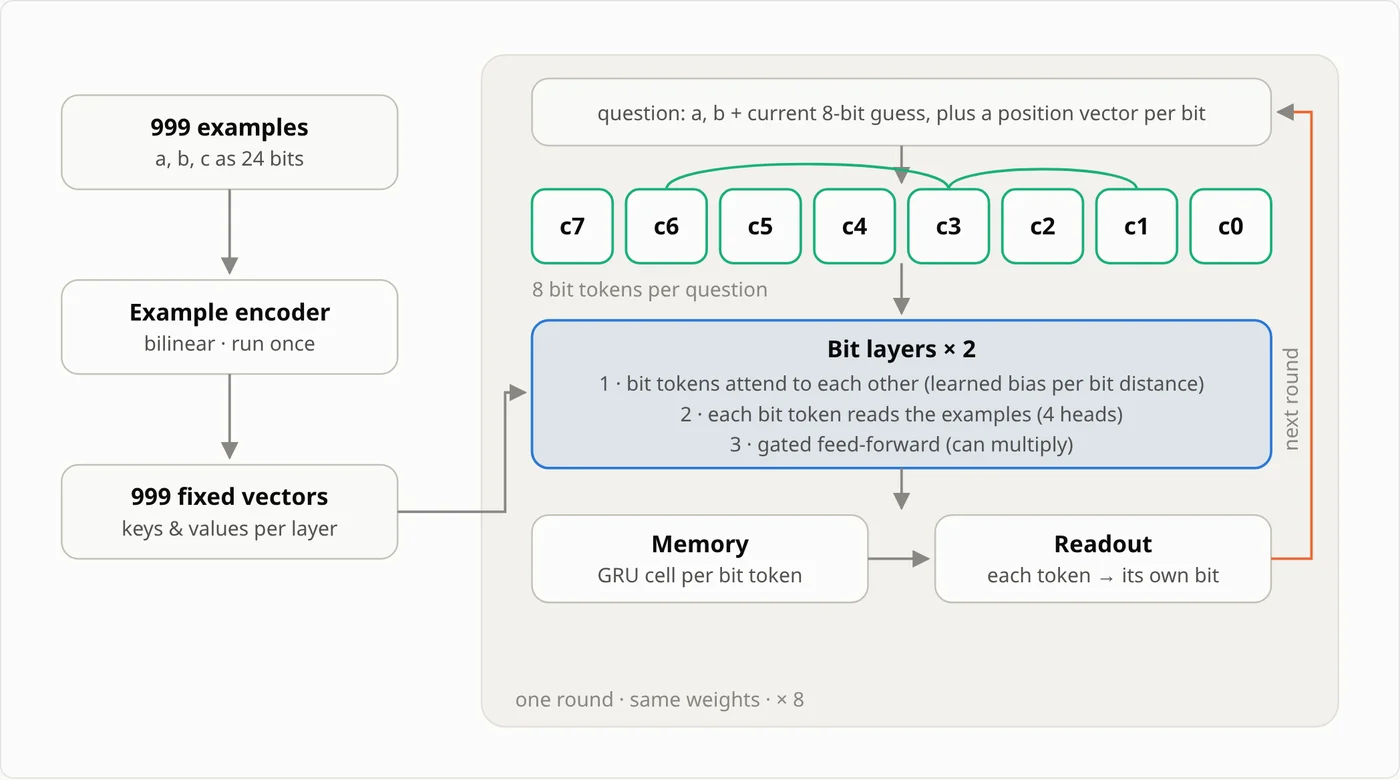
- Read the examples once. Each example’s bits go through a small bilinear encoder and become one fixed vector, with no reading order.
- Hold a guess. The answer starts undecided, split into one token per answer bit, each knowing which bit it is.
- Look and correct. Every round the bit tokens attend to each other, so carries can move between positions, then read the examples, then pass through a gated layer that can multiply signals. Eight rounds, the same weights each time.
- Answer honestly. Confidence is the certainty of the least certain bit, so the model can say when it doesn’t know.
The current model has 939,001 parameters and the same weights answer any width up to 32 bits: every layer sees bits relative to their own position, so nothing depends on the number size.
Results, next to a fair baseline
Every score is reported beside lookup: the best of five methods that understand nothing (copy the closest example’s answer, or match neighbouring bits across examples), chosen per relation after the fact. A score only counts where it clearly beats lookup.
| Relation, 32 bits | Teenie | Lookup |
|---|---|---|
| Sealed set: 24 everyday functions, never used for a decision | 37.8% | 21.4% |
a>b ? a−b : a+b, conditionals never trained | 77.0% | 1.1% |
rotl(a, b&7), rotations never trained | 25.2% | 0.5% |
| 2-operation expressions with a held-out pair | 31.7% | 19.6% |
a*b+b, a product then one more step | 0% | 0% |
When it is sure, it is almost always right: 99.9% of confident answers on the sealed set at 32 bits were correct, even where its overall score is low.
What failed, and why that’s published
The model computes a*b on its own, but a product followed by one more
step stays near zero at 32 bits. Trained on just four such relations it
solves them almost perfectly, so the failure is in recognising which
rule the examples come from when there are many candidates, not in the
arithmetic.
Getting here took more than twenty recorded experiments, and the dead ends are kept: recurrent models on floating-point values, a conjugate-gradient fitter that turned out to do all the work untrained, step-by-step supervision that held the model back, and a “program inference” design that could represent the answers but would not train. Each one, with its numbers and the command to reproduce it, is on teenie.lupyd.com.
Built to be checked
- Fresh problems every step: episodes are generated, never repeated, and held-out relations are excluded by behaviour, so rewrites of them are caught too.
- Adaptive sampling spends training on the relations it still gets wrong.
- A sealed test set of 24 functions written separately and evaluated once, so the model can’t be tuned to it.
- PyTorch with bf16 training on a single RTX 3050, managed with uv, strict mypy typing and pytest. The results site is Astro, generated from the experiment files.